When I was a very young child, I
believed that leaves turned into birds and flew south for the winter. Back in
those days, when I was trying to figure out how the world works, I got a lot of
convoluted ideas about life.
Surrounded by mostly adults out on
our farm, I listened to and interpreted their conversations the best I could.
My parents and siblings often talked about seasonal changes, of the birds
flying south for the winter in autumn, and of the leaves falling. Those two things
especially got mixed together in my mind. The next step in belief only required
a bit of magic.
And the world then was full of
magic, it seemed to me.
One autumn morning in about the third year of
my life, I sat on the front step of our house while my mother sat on the porch shelling
corn.
I should have been helping her with
the shelling, but mostly I sat there with an ear of dried corn on my lap and an
empty bucket at my feet, watching the wind blow. A strong blast shook the oak
tree in the front yard. That tree was a close and favorite friend of mine. A
couple bales of leaves drifted down to the ground below.
But as I watched, it appeared to me
that instead of all drifting down, some leaves drifted up and sailed over the cornfields and the trees, with beaks and
wings silhouetted against the wide, gray sky.
So I thought that special leaves, maybe the
most colorful ones, get to turn into birds and then fly south for the winter.
Kind of like going to heaven. It made perfect sense to me at the time.
When I told my mother what I had
discovered, she smiled and continued
with her corn.
A year or so later on the same
porch, again shelling corn, this time with one of my big sisters, I watched the
scenario play out with the oak tree in much the same way I remembered from
before. Sitting there idly with ear of corn in my lap, I told my sister about
how leaves turn into birds and fly south for the winter.
My sister put down her ear of corn,
sucked the blister on her thumb, and regarded me with a scowl.
“That’s the craziest thing I ever
heard a four-year-old come up with,” she said. “There must have already been
some birds roosting in that tree and they flew away when the wind got sharp. You’re
too dreamy. Everybody with any kind of sense knows that leaves are leaves and
birds are birds.”
“And you need to get busy,” she
added, indicating the empty bucket at my feet. “You’re old enough to shell more
corn than that.” She grudgingly went back to her work.
I looked down at the empty bucket as
devastation washed over me. My sister was a senior in high school. She could
tie her own shoes. She could read a book to herself.
She knew just about everything there was to know about everything.
I looked back up at the oak and
wondered, if leaves don’t turn into birds and fly south for the winter, how
could I even be sure that the stories that old tree had told me all summer were
true? Or that the tooth fairy could find my house? Or that someday, if I worked
at it hard enough, I could grow up to be a horse? And marry Elvis Presley?
I figured it would be better not to
mention things like that anymore. And so I haven’t. Mostly.
Fall is and always has been my
favorite season. As an adult, and a homeowner, I’m now almost completely
certain that the leaves on our trees don’t turn into birds and fly south for
the winter. Or at least, the majority of them don’t.
The majority of the leaves from our
trees, after a great deal of effort on the part of myself and my husband, spend
the winter at the bottom of the garden, turning into homemade dirt.
Which is not a bad end for a leaf.
It’s a nice spot down there, surrounded by hickory trees and oaks. I go down
there myself to sit in a little patch of sun that finds its way in, Scout and I, and the Devil Herself
of a morning sometimes.
Cup of coffee. Toast and jam. It’s
a nice place to sit and watch the wind blow when I should otherwise be working. I can listen to any stories the trees might care to tell. And its a good place to
keep watch in case any of the leaves get enough gumption to magic themselves
into birds and fly south for the winter. You never know.
Saying goodbye to my grown child was one of the most disorienting experiences I've ever lived through. Talk about cognitive dissonance.This was written after the exit of my youngest child and only son. I'm posting it today in sympathy with a great, life-long friend, Jackie, who just delivered her only girl, our Kristin, to a university several states from home.
A million miles of carpet covers the floor at the Atlanta
airport, and the walls are lined with art. Time expands and contracts
here.All around us people hurry along
wishing for more of it, or sit and wait, wishing for less.
In an invisible cone of privacy I say goodbye to my child,
my last one, my boy.Touching his
forehead at the hairline, I smooth back thick strands. I can’t help it.
I have
to reach up so far to touch his head now. There, just there, is a small whorl
of hair, like the eye of a storm.The
first time I saw it was the day I gave birth to him.
Photo by Chelsea Lindsey
Goodbye.
For him, the word is a portal, an opening, the beginning of
his new life at university, out in the world on his own.For me it is
the closing door of a house that I don’t live in anymore. I lower my hand and
take a step back. I think of all the things he doesn’t know yet. I breathe in. I breathe out.
The walls of the airport in Atlanta are lined with art, and
a million miles of carpet cover the floor. In an invisible cone of privacy I
stand on one small square, alone, an island in the great ocean of people all
around me.
Goodbye I say, goodbye, goodbye, as nineteen years and most of my life turns. He smiles and waves. Then he faces forward and dives headlong into the tide.
Not so long ago and
far away in another life, I was a storyteller. Here’s one of the stories I
often told this time of year:
Once upon a time, a long, long time
ago, I was a little girl in Alabama. Some things were the same then. Mamas and
Daddies loved their children. Spring came every year. Elvis was the King of Rock
and Roll. Some things were different. Little girls almost always wore dresses.
My mother made all of my clothes. Everybody we knew went to the same church
every Sunday. Twice.
I was the youngest child in the
family by many years, almost as young as a grandchild. I was not unappealing to look at, with blonde hair, blue eyes and a ready smile. Unfortunately,
I also had a busy brain and a mouth to go with it, and was forever asking
inconvenient questions at inconvenient times.
My mother,
God bless her, loved dressing me up for church on Sundays. So did my teenaged
sisters. I guess they thought they might as well have some kind of fun out of
me in exchange for putting up with my behavior for the rest of the week.
So on Saturday nights they picked
out my dress and slip and shoes and socks and underwear. They bathed me and
washed my hair. They slathered my hair with Dippity-Do and filled my head full
of itchy, pokey brush rollers. It was all more of a trial than any
four-year-old should ever have to endure.
But on the
Saturday night before Easter, these
ridiculous rituals would go into overdrive. My mother would have been working
for weeks by then, making her idea of the perfect Easter outfit for her baby.
One that that bristled with lace, embroidery, puffed sleeves, ribbons and bows.
My mother and sisters would turn me into a pastel petit four for the day, an
overly frostedlittle pink and white
cupcake with blonde hair. An Easter confection.
Of course,
I did not want to be a little pink and white Easter confection at that time in
my life. Back then, my goal was to someday, eventually, grow up to be a horse
and/or marry Elvis Presley. His magazine photos were plastered all over the
walls of the bedroom I shared with my big sisters.
To that end, I got together with my
imaginary friend, Darlene, every day. And when Darlene arrived, it was the
easiest thing in the world to pretend Elvis up for a visit to our house, as
well. Once there, he would very obligingly play whatever game Darlene and I had
gotten going, with my dog, Chipper, and my pet chicken, Irmengarde in tow. Darlene
and I could always count on Elvis to liven up an otherwise dull afternoon.
But, oh, those Easter weekends! The newness of those clothes! I hated the scratch of lace. I hated the binding of ribbons and elasticated
puffed sleeves. And the unforgiving white patent leather shoes. And white
cotton gloves, for goodness sake. And a straw hat with an elastic strap under
my chin. Horrors.
I failed to understand how the
wearing of castoff boy's britches and tennis shoes and a t-shirt to church on
Easter Sunday could prevent the Easter Bunny from coming or Jesus from rising
from his tomb. It was all very confusing.
But my mother and sisters were on a
mission. A mission to try to make me the cutest little Easter brat at Mamre Baptist Church. So,
with my hair let down and combed out, they worked me into new underwear, socks,
shoes, gloves, and confectionery dress. Then I was made to stand on the little
bench in front of my mother’s dressing table, where I could see myself in the
big, round mirror from head to toe, and be admired by all the females of the
family.
So there I stood on the Easter
Sunday morning of my fourth year, a successfully potty-trained human being who
had left her high chair far behind. Stuffed into itchy, binding clothes, my
stiff, sprayed hair in a perfect “flip” around my shoulders, I felt like
some sort of sacrificial lamb to fashion. Oh, the indignity.
I stared in the mirror, feeling my
pre-school gorge rise, until finally, I exploded. First I kicked off the shoes and
wrenched off the gloves and socks. I threw the hat across the room and began
to tug at the ribbon around my waist. Next I pulled the hated dress over my head, that object of all those hours of my poor mother's loving work. As I tugged and wriggled and twisted off those clothes, I growled and whimpered like a caged animal.
And then there I was on the little
bench, staring up at my mother, wearing only my little white cotton slip and panties. My face was
blotchy, my hair enmeshed in tangles from the struggle to disrobe. Without a
sound, my sisters melted out of the room.
From the doorway, my mother stared
back at me, outwardly calm, inwardly seething. But she had been a mother much
longer than I had been a child. She was much smarter than I was. And more
patient. As she opened her mouth to say something, the kitchen phone
rang.
“You stay right there and don’t you
move, young lady. I’ll be back to deal with you in a minute.”
So I stood, sniffling and trembling
with anger. Darlene appeared. I began to tell her my troubles. My mother soon
returned and stood at the door, watching me talk to the empty air around me. My
abandoned clothes had come to rest in various unlikely places around the
bedroom she shared with my father.
Curiosity being one of my foremost
character flaws, I turned my attention to her. “Who was that on the telephone, Mama?”
I asked, still sniffling.
My mother’s expression changed then.
Her eyes took on a shrewd look. She was wise enough to recognize an opportunity
when one presented itself.
“Who that was on the phone, young
lady,” she said, “was Elvis.”
I stopped sniffling. Darlene disappeared
back from whence she came in an instant. My mother had my full attention now.
“Elvis heard about the outfit I’ve
been sewing for you this Easter. He wanted me to take a picture of you wearing it.”
Here my mother nonchalantly studied the nails on her left hand. “I told him I’d see
what I could do, but not to expect too much, because you were cutting up such didoes
about it.”
I exploded again, this time into
action. Running around the room, I gathered up the hated clothes, talking a
mile a minute about how I’d have them on before she knew it, how I’d comb my
own hair and buckle my own shoes, and if she would just go get my brother’s
camera, I would stand very, very still, and smile real pretty, and be good the rest of the
day. No. I’d be good forever and ever. And ever. Amen.
Mother disappeared down the hall
and shortly returned with the camera and my sisters. They made a couple of adjustments
to my ensemble and took me outside. Darlene waited for me there in front of the
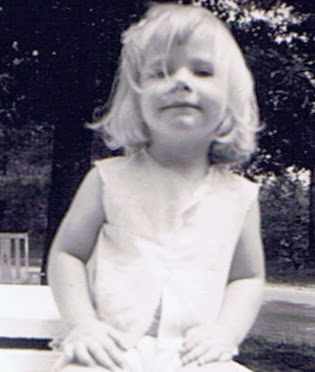
camellia bush. And that’s where my mother snapped my photograph. For the King.
Then my family piled into the car and
headed to church like every other Sunday of our lives. Darlene waved us all the
way down the road to the turnoff.
I’m sure my Easter basket was
lovely that year. I’m sure I hid eggs and ate candy and had a wonderful day.
But what I remember most about that Easter is imagining the look on Elvis’s
face, all the way up in Memphis, when he got my picture in the mail. At
Graceland. Who really wants to be a horse when they grow up anyway?
I have lived through a fair few
Easters since that one. I think about those years sometimes, of my family, and
the world we knew then. I think about Darlene. She must surely be getting as
long in the tooth as I am, these days. I miss her.
Not long ago, I visited Graceland.
I did not see my photo there. I’m sure it must mean that Elvis carried it with
him always, perhaps in his wallet. I like to think he could see Darlene in that
picture with me. That Elvis Presley had the only existing photo ever taken of the
two of us together, all those years ago. I like to think that somewhere out
there in the cosmos, it’s with him, still.
It began to rain the morning after that long night. Rain in
the daytime, something I didn’t see muchin southern California. I was homesick
for it. Therewas an atrium in the middle of the ward. You and I walked around
it a long time, watching the sky. Listening to the drops fall from leaf to leaf. I leaned on a handrail when the pains came. One after another the
other babies appeared until there was just one name left on the board at the nurses' station. Mine. Your
father went to check on your sister, then to pick my mother up from the
airport. In between he held my hand, letting go only when I grabbed that
handrail. You were born late in the afternoon. You answered a question I’d been
asking myself for months. How will I ever love this one as much as I love the
first one? This is how. Like this. Just like this. Here you are. Just as much. Always have,
always will.